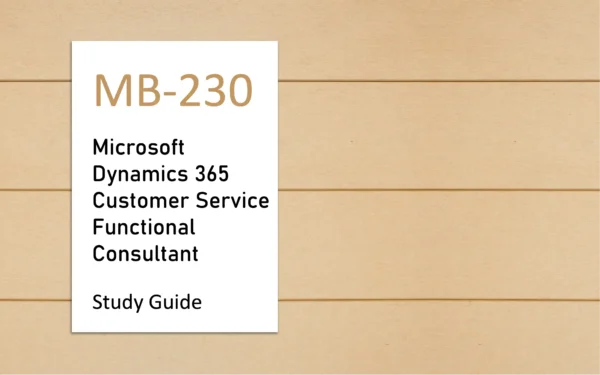
MB-230 Preparation Details
Preparing for the MB-230 Microsoft Dynamics 365 Customer Service Functional Consultant certification exam? Start here with a complete, objective-wise MB-230 study guide designed to help you pass faster.
This guide brings together official Microsoft documentation, key concepts, and curated resources for every MB-230 exam objective, making it ideal for both beginners and last-minute revision.
Looking for the best MB-230 preparation resources in one place? This page covers everything you need to get exam-ready with confidence.
If this helped you, share it with others preparing for the MB-230 certification exam.
Exam Voucher for MB-230 with 1 Retake
Get 40% OFF with the combo
MB-230 Microsoft Dynamics Materials
Manage cases in Customer Service (51–55%)
Define and configure foundational Customer Service components
Implement and monitor record creation and update rules
Automatically create or update records in Dynamics 365 Customer Service
Set up rules to automatically create or update records
Configure and modify the case resolution experience
Modify the case resolution dialog
Configure and manage security roles
Copilot Service admin center in Customer Service
Manage Copilot features in Customer Service
Configure the timeline control, including records, card forms, and highlights
Work with cases in Dynamics 365 Customer Service – Training
Create and administer knowledge management
Configure internal knowledge search capabilities
Configure knowledge management
Overview of knowledge management
Configure tables for knowledge management
Configure knowledge management
Copilot Service admin center in Customer Service
Manage translated knowledge articles
Overview of knowledge management
Configure knowledge management
Integrate and search external knowledge sources
Enhance Copilot responses with knowledge from additional sources
Enable knowledge sources from Microsoft Copilot Studio (preview)
Configure AI suggestions and Copilot-led knowledge article creation
Enable Copilot to suggest knowledge from cases (preview)
Manage Customer Knowledge Management Agent
Manage collaboration
Configure Microsoft Teams chat
Configure Microsoft Teams chat in Customer Service
Configure Microsoft Teams collaboration
Configure Join a Teams call for specific users
Set up Join a Teams call for customer service representatives
Configure suggested contacts in Microsoft Teams, including by using AI and rules-based suggestions
Configure Microsoft Teams collaboration
Configure Teams collaboration experience
Configure Microsoft Teams collaboration
Configure Microsoft Teams chat in Customer Service
Manage agents and Copilot in Service features
Configure Ask a Question, including filtering content
Manage Copilot features in Customer Service
Configure case, timeline, and conversation summaries
Enable Copilot case and conversation summaries
Configure Copilot in Dynamics 365 Customer Service – Training
Configure Draft a Response
Manage Copilot features in Customer Service
Onboard your users to use Copilot in your digital contact center
Configure the Case Management Agent
Manage Customer Knowledge Management Agent
Manage Copilot features in Customer Service
Integrate agents with Customer Service, including plug-ins and knowledge sources
Integrate knowledge management in Dynamics 365 with Copilot agents
Enable knowledge sources from Microsoft Copilot Studio (preview)
Create and manage SLAs for cases
Configure SLA settings
Configure service-level agreements in Dynamics 365 Customer Service
Overview of service-level agreements
Implement actions by using Power Automate
Configure service-level agreements in Dynamics 365 Customer Service
Apply SLAs
Overview of service-level agreements
Create and manage SLA items including KPIs, warning actions, success actions, and applicability
Configure service-level agreements in Dynamics 365 Customer Service
Overview of service-level agreements
Configure a timer control on a form
Add a timer control for SLA-enabled entities
Add timer in forms to track time against enhanced SLAs
Create SLA KPIs
Configure service-level agreements in Dynamics 365 Customer Service
Overview of service-level agreements
Configure representative experience and routing (25–30%)
Configure routing
Configure workstreams
Configure user settings
Create and manage users and user profiles
Use best practices to set up unified routing in Customer Service
Manage capacity profiles
Create and manage capacity profiles in Dynamics 365 Customer Service and Dynamics 365 Contact Center
Configure work classification and assignments, including rules
Configure work classification rulesets for unified routing
Configure basic routing rulesets
Set up unified routing for records
Configure skills-based routing and skill finder models
Set up skill-based routing in unified routing
Configure work classification rulesets for unified routing
Configure queues
Create and manage queues for unified routing
Configure routing for records
Set up unified routing for records
Configure productivity tools
Configure scripts, including slugs
Use automation dictionary to pass parameter keys
Create macros
Configure macros to improve representative productivity
Use automation dictionary to pass parameter keys
Configure the Copilot Service workspace
Configure session templates
Associate templates with workstreams
Create experience profiles
Create and use experience profiles
Overview of experience profiles
Configure the Inbox, including creating custom views
Create and use experience profiles
Configure application tab templates
Manage application tab templates
Associate templates with workstreams
Extend Customer Service (15–20%)
Configure the data model and UI components
Create and configure forms
Create and design forms for Customer Service Hub
Create, edit, or configure forms using the model-driven form designer
Create and configure views
Overview of building a model-driven app with Power Apps
Create and edit public or system model-driven app views
Configure model-driven app components
Overview of building a model-driven app with Power Apps
Add or edit model-driven app components
Create and configure columns
Column data types in Microsoft Dataverse
Create and edit columns for Dataverse using Power Apps
Configure alerts and in-app notifications
Send in-app notifications within model-driven apps
Manage notification settings and templates
Create or modify a table
Create and edit tables using Power Apps
Configure relationships
Create and edit relationships between tables
Types of table relationships in Microsoft Dataverse
Configure Dataverse search
Configure Dataverse search for your environment
Create and manage email templates
Create email templates in Customer Service
Use email templates to create consistent, professional email messages
Capture customer feedback by using Customer Voice
Trigger distribution of a survey
Integrate Dynamics 365 Customer Voice with Dynamics 365 Customer Service
Create a survey invitation by using Power Automate
Configure post-conversation survey using Customer Voice
Personalize a survey
Automate Dynamics 365 Customer Voice surveys with Power Automate – Training
Populate survey results against cases and conversations
Integrate Dynamics 365 Customer Voice with Dynamics 365 Customer Service
Configure post-conversation survey using Customer Voice
This brings us to the end of the MB-230 Microsoft Dynamics 365 Customer Service Functional Consultant Study Guide.
What do you think? Let me know in the comments section if I have missed out on anything. Also, I love to hear from you about how your preparation is going on!
In case you are preparing for other Microsoft Dynamics 365 certification exams, check out the Microsoft Dynamics 365 section for those exams.
Follow Me to Receive Updates on the MB-230 Exam
Want to be notified as soon as I post? Subscribe to the RSS feed / leave your email address in the subscribe section. Share the article to your social networks with the links below so it can benefit others.